


Protecting Place, Honoring Community
Cheryl and Steve Honard aren't your typical landowners. The newest NVCT conserved property is a pocket park just down the street from where Cheryl and Steve live in Loudoun. While the Honards care deeply about preserving open space for their community, their decision to protect their property was rooted in something far more personal. Today, the small 0.33-acre park features benches, a mulch path, and plantings throughout. At one corner stands a large boulder beneath a mature oak tree, bearing a plaque that commemorates firefighter Trevor Brown, who lost his life in the explosion of the home that once stood on this site. Honoring his memory became the Honards’ reason for purchasing the land and transforming it into a memorial park for the community.
What first motivated you both, personally, to step in and purchase the property after the explosion?
“Well, we've lived in the community for almost 40 years, and we've seen a lot. And we've seen a lot of people pass away. And we've had hurricanes, tornadoes, you name it, even earthquakes. We've seen a lot of things where people are tearing down houses and putting up McMansions.”
Something they noticed about this property was that being on a corner made it perfect for community gatherings. Children can often be seen climbing on benches and running throughout with their parents after being picked up from school. “This lot was right, was central to everything, and would be a perfect spot for the community,” said Cheryl Honard.
“We didn't have any common areas. When the development was built, there wasn’t much space. There's no pool, no benches, no amenities for the community.” However, the biggest motivator was Cheryl’s connection to firefighters.

Cheryl, I read that you come from a family of first responders. How did your upbringing influence your decision to turn this site into a memorial park?
“My dad was a firefighter, a volunteer firefighter. My stepfather was a volunteer firefighter. And we used to go on many calls with them. We never expected him not to come home. My dad did a lot for the community. It was a community service, and this young man lost his life on this property. I didn't think it would be right for somebody to buy the property, put up a McMansion, and make money from it, and then we forget about the person who died here serving the community.”
Cheryl reflected on memories of her father and his connection to the people he served. “When my dad passed, he was honored. I want the same for Trevor.”
Why was it important to you that the site not be rebuilt for housing but instead become green space?
Cheryl and Steve explained that the explosion left both physical and emotional damage to the community. Debris remained in trees for a year; nearby homes had to be rebuilt, and neighbors were deeply shaken. Some even refused to walk near the area because the event impacted them so profoundly.

“Their houses had to be rebuilt. Their kids were traumatized, you know, and it was like it affected not just that one place, but it also affected the whole community.”
In their view, replacing the home with another house would erase Trevor’s memory—and eliminate the possibility of something restorative and meaningful growing in its place.
What was your vision for the park in terms of community healing, remembrance, and nature?
“We definitely wanted something that was a memorial for Trevor Brown so the community could heal. Our original vision was more of a grassy area with a few trees, and an area with gardens for kids to plant in.”
Cheryl and Steve believed they would be responsible for bringing this vision to life, but to their delight, members of the neighborhood stepped in to help.
“Originally, we had no idea we were going to have help from any outside sources. We were doing it all on our own. We went around and we got some people who donated things out of their kindness, like the fence surrounding the park.” A local landscaping company that had worked with several neighbors offered to design the entire park for free. “The price was zero. It was like, oh wow. Yes. Thank you so much! So please give him a good review, and he's happy. So, we're all happy!”
Since the original design and installation, the Honards have imagined future improvements—additional green space, more shade trees, planter boxes, and even areas for kids to explore nature. “I imagine the kids having a butterfly garden, and bluebird houses throughout!” Local birders and Master Gardeners have since offered their expertise, making these dreams feel achievable.
Can you walk me through how you negotiated the purchase with the previous owner?
“The previous owner was going to move; she had no intention of rebuilding the house, and she was going to put it on the market.” The Honards worried that if it went directly for sale that a developer would buy it and build another house.
Cheryl described the moment everything changed: “We called her up and said, ‘Hey, we would like to buy it and turn it into a memorial space.’ And she said, ‘I think we can make that happen,’ and I started crying. I was like, ‘Oh, really? Oh, my God. Oh, my God, yes!’ So I asked her if we could purchase it rather than try to have a bidding war for it. I just asked her if we could buy it for the tax assessed value. She agreed, and after getting the property assessed, we made her an offer and she accepted.”
How did you engage with the Northern Virginia Conservation Trust in making this park happen?
The Honards were unfamiliar with park management and unsure how to bring their vision to life. They first considered donating the property to the HOA but later learned it wasn’t feasible. Cheryl began searching online for alternatives. “Cherry came across the idea of a conservation easement. There's been a lot of news recently about protecting farms out here, so she looked it up and we found on Loudon County's website that they had a list of conservation organizations.”
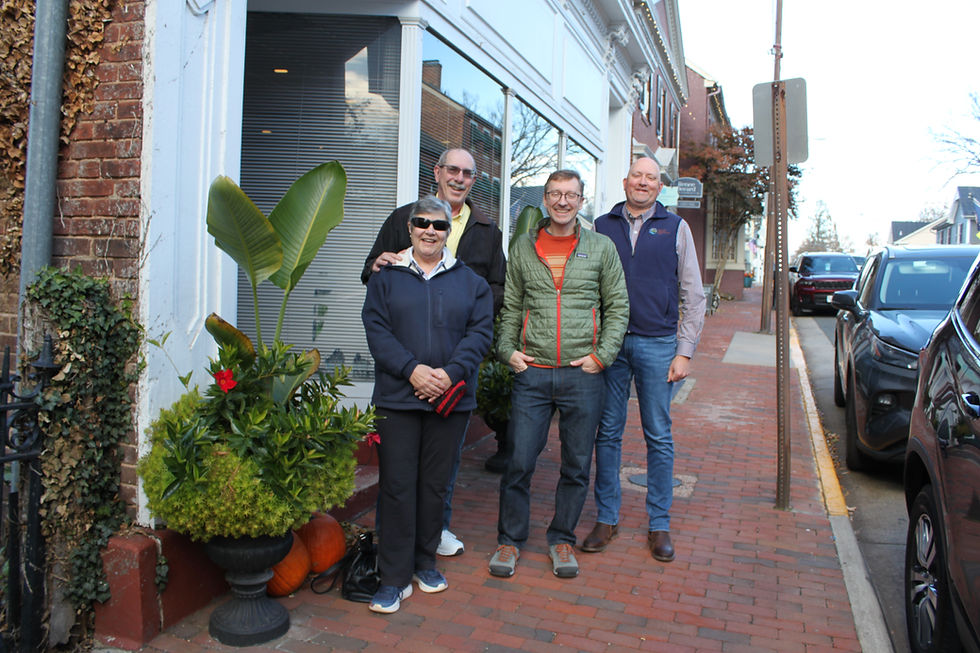
They reached out to all of them and were most inspired by how enthusiastic Matt Gerhart, NVCT’s Conservation Director, was about the project. “Matt came back and he said ‘Hey, we would love to talk to you about this, this is the exact kind of thing we do.’
You decided to place the land in a conservation easement. Can you talk about why that was meaningful and how you see the long-term stewardship of the land?
“I think it’s important because we don’t think this site is the right place for more development, and we wanted it for the community. It wasn't meant to be private; it is now for the community to come enjoy; to bring everybody together. Up until now, people haven’t been brought together. We wanted to change that.”
The centerpiece is a large boulder with a plaque honoring FF Trevor Brown. How did you decide on that as the memorial symbol?
“It just came to us; we had decided that instead of a tombstone we wanted something natural like a rock.”
Cheryl and Steve searched across four states for the perfect boulder. Someone helping with the park invited them to look through a field full of rocks. “After that, I saw it.” Cheryl described the boulder as a “sleeping giant.” “Trevor was a big guy, and this rock just looked like a huge giant curled up sleeping.”

A local Boy Scout chose the plaque as his Eagle Scout project: “He coordinated with the groups involved and raised money to put the plaque in. He helped dig holes and planted trees.”
The widow of Fire Fighter Brown decided what the plaque should say; a quote from Trevor himself. It reads “It doesn’t matter what bad events occur, there will always be good. I get stronger with each hardship I face. I learn and grow from all events, good ones and bad ones.”
There is a three-story oak tree that survived the blast — was preserving that tree part of your plan, and what does it symbolize for you?
“It was part of the plan; the strength of the mighty oak saved it,” said Steve. Like the community, the oak survived the tragedy and continues to grow. The memorial boulder rests in its shade, emphasizing resilience and peace. \
How do you hope people will use this park?
“For quiet reflection, community gathering, ceremonies, walking, sitting on the benches, reading books, maybe having picnics. Or maybe something with the little kids like having a BYOP day. Bring your own plant!”
The Honards shared a powerful story about their neighbor Nancy, who, while undergoing cancer treatment, used the park as a space to rest during short walks. “She would come down, maybe a quarter of a mile from her house, and she would sit on the bench, rest, relax, contemplate, and then walk home.”
What has the reaction from the Trevor Brown family been to the transformation of that space?
“When we first said we were going to do this, Laura, Trevor’s wife, gave us a check to get the funding started.” Laura attended meetings, approved plans, and remained actively involved throughout the process.
As neighbors yourselves, how do you feel the park will change the neighborhood’s relationship to that site, and to each other?
“Trauma relief and a nice space to relax and gather. We hope it can bring the community together as well.” Cheryl added ideas for future events, including a community planting day.
How did working with a land-conserving organization (like Northern Virginia Conservation Trust) make a difference in this project?
“You helped so much! It was a breath of fresh air. Matt (Matt Gerhart, NVCT Conservation Director) hooked us up with lawyers and was so organized. We didn’t know any of this existed, and we were given a roadmap. Matt kept us informed the entire way. It was seamless and we thought to ourselves, ‘where did you come from? You saved us!’”
Cheryl and Steve Honard’s belief and vision demonstrate how personal loss, community need, and a deep respect for public service can come together to create something profoundly meaningful. What began as a response to tragedy has become a space for healing, remembrance, and connection—a place where neighbors gather, children play, and the memory of Trevor Brown is honored every day. Through their dedication and their partnership with NVCT, the Honards have ensured that this land will remain a place of reflection and community gathering for generations to come.


What a complete and total failure to the mission and the community. The Honards have dismantled and destroyed the FF Brown Memorial Park physically and also renamed it to their own liking. They should be ashamed.